CMAT Previous Year Papers: Complete Guide + Mock Test for 2026 Aspirants

Introduction to CMAT Previous Year Papers
Preparing for CMAT becomes significantly easier when you start solving CMAT Previous Year Papers (PYQs). These papers give you the closest possible understanding of what the actual exam feels like — question style, difficulty level, time pressure, and topic distribution. While mock tests are useful, CMAT PYQs show the exact logic, structure, and flow the National Testing Agency (NTA) follows.
For CMAT 2026 aspirants, learning how to use previous papers strategically is one of the most effective ways to build confidence, accuracy, and exam readiness. This guide walks you through everything you need to know - from year-wise papers to difficulty analysis, smart preparation methods, and B-school insights.
Most students begin CMAT exam preparation by solving previous year papers because:
- They offer real exam experience
- They help identify strengths and weak areas
- They highlight topic-wise trends
- They reveal question patterns mock tests sometimes miss
- They train your brain to think at CMAT speed
The CMAT last year paper especially becomes the starting point for many aspirants since its pattern remains closest to what the upcoming exam will follow.
Additionally, CMAT question papers with solutions help you understand why an answer is correct — not just what the right option is. This builds conceptual clarity and reduces guesswork in the final exam.
Free CMAT Previous Year Papers (Solved PDFs)
Get all papers + solutions in one place
Practice CMAT 2026 with a Free Mock Test
Solving CMAT previous year question papers helps you understand the exam structure and question types. However, mock tests help you practice CMAT in a real exam environment, where time management and accuracy play a crucial role.
Our CMAT mock test is designed as per the latest NTA CMAT exam pattern and covers:
- Quantitative Techniques & Data Interpretation
- Logical Reasoning
- Language Comprehension
- General Awareness & Innovation & Entrepreneurship
This mock test helps you evaluate your preparation level before the CMAT 2026 exam.
What Is the CMAT Exam? – Quick Overview
The Common Management Admission Test (CMAT) is a national-level management entrance exam conducted by the National Testing Agency (NTA). It evaluates candidates across:
- Quantitative Techniques & Data Interpretation (QT & DI)
- Logical Reasoning (LR)
- Language Comprehension (English)
- General Awareness (GK)
- Innovation & Entrepreneurship (introduced in 2021)
CMAT is considered a moderate-difficulty exam, accessible to students who are strong in basics and have good accuracy. Many top B-schools across India accept CMAT scores, making it a popular choice among MBA/PGDM aspirants.
A key advantage of CMAT is that it focuses on conceptual understanding rather than extremely tough or tricky questions. This makes it suitable for candidates preparing alongside jobs or college.
CMAT Previous Year Papers with Solutions (PDF Download – Year Wise)
Practising CMAT previous year papers is one of the smartest ways to build real exam temperament. These PDFs show actual question framing, section balance, and time pressure—things mock tests sometimes fail to replicate. The more you solve, the more familiar the exam starts to feel.
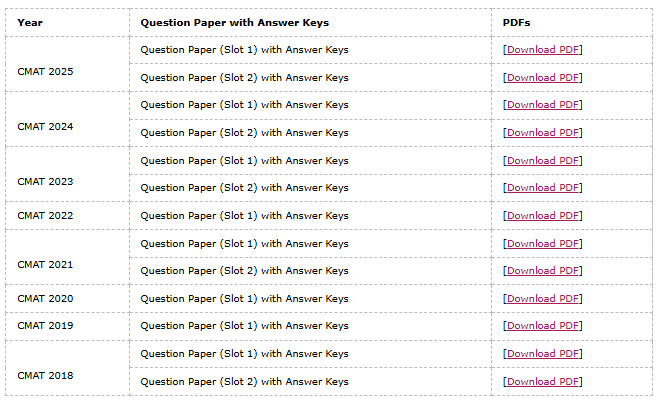
Below is a year-wise breakdown of CMAT question papers with solutions in a structured table for clarity:
Year-Wise CMAT Question Papers PDF Table
Solved CMAT Previous Year Papers? Try a Timed Mock Test
Once you have practiced CMAT previous year papers, the next step is to check how well you perform under actual exam conditions. A full-length mock test helps you handle time pressure, improve question selection and minimise negative marking.
Regular CMAT mock tests help you:
- Improve speed and accuracy across sections
- Identify weak areas early
- Build confidence for exam day
Year-Wise Highlights of CMAT Previous Papers
CMAT 2024
- Balanced difficulty
- Data Interpretation needed careful reading
- English remained moderate
- Useful for learning the latest trend shifts
CMAT 2023
- Student-friendly with easy to moderate LR
- Quant was doable
- Great for confidence-building
CMAT 2022
- GK was comparatively tricky
- QA and LR followed logical patterns
- Good for tracking repetitive topics
CMAT 2021
- Significant because of the new Innovation & Entrepreneurship section
- Highly recommended for 2026 aspirants
CMAT 2020
- Classic CMAT structure
- Ideal for strengthening fundamentals
Why CMAT Previous Year Papers Are Important
1. Understand Real Exam Pattern
PYQs help you identify:
- Section-wise question distribution
- Difficulty variations
- Common RC passages and reasoning styles
- Typical DI presentation formats
This is far more reliable than depending solely on mock tests.
2. Spot Repeated Question Types
Certain CMAT topics appear frequently:
- Arithmetic (Percentages, Ratios, TSD, Profit & Loss)
- Grammar correction and vocabulary
- Logical puzzles
- Static GK topics
Identifying these helps create a focused study plan.
3. Build Time Management Skills
CMAT gives you enough time, but precision matters. PYQs teach:
- Which questions to attempt first
- How long to spend on logic puzzles
- When to skip and move ahead
Many toppers emphasise that solving past papers improved their speed more than coaching modules.
4. Boost Accuracy and Reduce Negative Marking
Because CMAT follows a +4 / –1 marking scheme, accuracy can make or break your score. Practising previous papers helps refine accuracy and reduce careless mistakes.
CMAT Exam Pattern 2026 – Latest Format
CMAT 2026 is expected to follow the same structure as recent years:
Section | Questions | Marks |
Quantitative Techniques & DI | 20 | 80 |
Logical Reasoning | 20 | 80 |
Language Comprehension | 20 | 80 |
General Awareness | 20 | 80 |
Innovation & Entrepreneurship | 20 | 80 |
Total Questions: 100
Total Marks: 400
Marking: +4 for correct, –1 for wrong
Difficulty Level: Moderate
The stable structure makes CMAT predictable and easy to plan for.
CMAT Syllabus 2026 – Topic-Wise Guide
1. Quantitative Techniques & Data Interpretation
Topics include:
- Arithmetic
- Algebra
- Number Systems
- Geometry
- DI (Tables, Charts, Pie Charts, Caselets)
This section is scoring with consistent practice.
2. Logical Reasoning
Includes:
- Puzzles
- Series
- Coding–Decoding
- Blood Relations
- Statement–Assumption
- Direction Sense
Most questions are logical rather than calculation-heavy.
3. Language Comprehension
Covers:
- Reading Comprehension
- Para-jumbles
- Sentence correction
- Vocabulary-based questions
- Grammar
RC passages are typically short to moderate.
4. General Awareness
Includes:
- Current Affairs
- Static GK
- Indian polity
- Economy
- Geography
- Awards, Sports, Books & Authors
This section can vary widely in difficulty.
5. Innovation & Entrepreneurship
Topics include:
- Startup culture
- Business models
- Innovation strategies
- Market insights
- Entrepreneurship cases
Introduced recently, but heavily conceptual.
How to Use CMAT Previous Year Papers Effectively
- Solve Under Exam Conditions
Recreate real test timing and environment. No distractions, no pausing. This builds mental stamina.
- Analyse Every Mistake
Ask yourself:
- Did I misread the question?
- Was the concept weak?
- Was I rushing?
This prevents repeated errors.
- Create Section-Wise Strategies
For example:
- Attempt LR and English first
- Save GK for later
- Allot extra time for DI-heavy quant questions
4. Revisit Papers Regularly
Track your improvement:
- Accuracy changes
- Time spent per section
- Familiarity with patterns
- Mix PYQs with Mocks
PYQs show real patterns; mocks teach adaptability.
CMAT Previous Year Papers Difficulty Level Analysis – Trends Over Years
Over the past few years:
Quantitative Techniques
- Mostly moderate
- DI can be time-consuming
- Arithmetic dominates
Logical Reasoning
- Moderate and familiar
- Puzzle variety remains stable
Language Comprehension
- Very manageable for readers
- Focus on meaning and vocabulary
General Awareness
- Unpredictable; varies widely year to year
Innovation & Entrepreneurship
- Conceptual, sometimes theoretical
- Easy if familiar with business basics
Overall difficulty: Moderate, but GK and I&E can occasionally surprise.
Preparation Tips After Solving CMAT PYQs
- Identify and Strengthen Weak Areas
If quant mistakes are conceptual, revise fundamentals first.
If GK is weak, read summaries weekly.
- Revisit Incorrect Questions
Try solving them again after a week.
- Maintain a Formula & GK Revision Sheet
Quick daily revision improves retention.
- Solve a Mix of PYQs + Fresh Mocks
A balanced approach prevents stagnation.
- Improve Reading Speed and Vocabulary
This helps in both English and GK.
Expected CMAT Cutoffs Based on Previous Trends
While cutoffs vary by year and institute, here are general trends:
Top CMAT-Accepting Colleges
- JBIMS (Through DTE CAP) – High percentile requirement
- SIMSREE – 95–99 percentile
- KJ Somaiya (Autonomous Process) – 92–95 percentile
- Goa Institute of Management – 85–90 percentile
Other reputed institutes
- Typically accept 80–90 percentile
Your performance in GK and I&E strongly influences percentile because many aspirants score low in these sections.
Why ITM Is a Top Choice After CMAT Exam
- Practical Learning Environment
ITM Business School is known for:
- Corporate exposure
- Skill-based modules
- Application-driven curriculum
- Wide Range of Specialisations
- Marketing
- Finance
- HR
- Retail Management
- FinTech
- Business Analytics
- Operations
- International Business
- CMAT Score Acceptance
ITM accepts:
- CMAT
- CAT
- XAT
- GMAT
- ATMA
- MAH-CET
Selection includes:
Entrance score + academics + interview + micro-presentation.
- Strong Placements
Recruiters from:
- BFSI
- FMCG
- IT & Analytics
- Consulting
- Retail
Students earn competitive packages with structured roles.
- High ROI for Students
ITM balances:
- Industry exposure
- Academic excellence
- Affordability
- Career readiness
Conclusion
CMAT Previous Year Papers serve as a roadmap for smart, structured preparation. They reveal exam difficulty, question trends, and sectional weightage far more accurately than any book or coaching module. With every paper you solve, your speed improves, concepts become clearer, and confidence grows.
For CMAT 2026, your goal should be simple:
- Practise PYQs
- Analyse mistakes
- Build smart strategies
- Stay consistent
Whether you’re targeting top-tier B-schools or practical, industry-focused programs like ITM, a strong CMAT score backed by intelligent preparation can open multiple career doors.
Consistency beats intensity - one step at a time, one paper at a time.
FAQs on CMAT Previous Year Papers
Where can I download CMAT previous year papers?
From NTA’s official website and trusted MBA preparation portals.
How many CMAT papers should I solve?
At least 5 years of papers for clarity and pattern recognition.
Are CMAT PYQs enough for exam preparation?
They’re essential but should be paired with mock tests and revision.
Do CMAT questions repeat?
Not exactly, but formats and concepts repeat frequently.
Is CMAT easier than CAT?
Yes, CMAT is more concept-based and moderate in difficulty.
How do CMAT solutions help?
They explain the logic behind answers, improving accuracy.
Does ITM accept CMAT scores?
Yes, ITM accepts CMAT for PGDM admissions across its campuses.