NMAT Previous Year Question Papers: Complete Guide + Mock Test for 2026

Introduction to NMAT Previous Year Papers
Preparing for NMAT can feel different from preparing for CAT, XAT, or other management exams. NMAT is fast-paced, adaptive, and strategy-heavy. It rewards clarity, speed, and accuracy rather than solving extremely difficult problems. That’s exactly why NMAT Previous Year Papers (PYQs)—even though memory-based—are among the most reliable tools for building confidence and understanding the real exam pattern.
This guide breaks down everything you need to know: what NMAT PYQs really are, how to use them effectively, difficulty level analysis, cutoffs, and smart strategies for 2026 aspirants.
NMAT previous year papers are often the first resource students look for while starting preparation. Why? Because PYQs show:
- How NMAT frames its questions
- Which topics appear often
- How the adaptive pattern behaves
- What difficulty level to expect
- How fast you must move in each section
Aspirants mainly rely on memory-based NMAT papers, as GMAC doesn’t release official past papers. Even though they aren’t 100% exact, these reconstructed papers are extremely helpful for understanding trends, patterns, and question types.
Many students say solving NMAT PYQs was the turning point in their preparation — especially in understanding section timing, improving accuracy, and learning how the adaptive test adjusts difficulty.
Free NMAT Previous Year Papers (Solved PDFs)
Get all papers + solutions in one place
Practice NMAT 2026 with a Free Mock Test
Practicing NMAT previous year question papers helps you understand the exam structure, but NMAT mock tests help you master speed, accuracy and section-wise strategy - which are crucial because NMAT allows multiple attempts.
Our NMAT mock test is designed as per the latest GMAC exam pattern and covers:
- Language Skills
- Quantitative Skills
- Logical Reasoning
This mock test helps you assess your performance and plan improvements for your next NMAT attempt.
What Is the NMAT Exam? – Full Overview
The NMAT by GMAC is a widely accepted management entrance exam for MBA/PGDM programs at institutions such as NMIMS and several other reputed business schools.
Key features of the NMAT exam include:
- Adaptive format: question difficulty changes based on your responses
- Three sections: Language Skills, Quantitative Skills, Logical Reasoning
- Equal weightage across sections
- Strict sectional timing
- Multiple exam attempts allowed
- Flexibility in choosing test dates and slots
Candidates appreciate NMAT because it tests practical aptitude rather than extreme difficulty. The exam focuses on clarity, structured thinking, data interpretation, and language comprehension — skills essential for modern management roles.
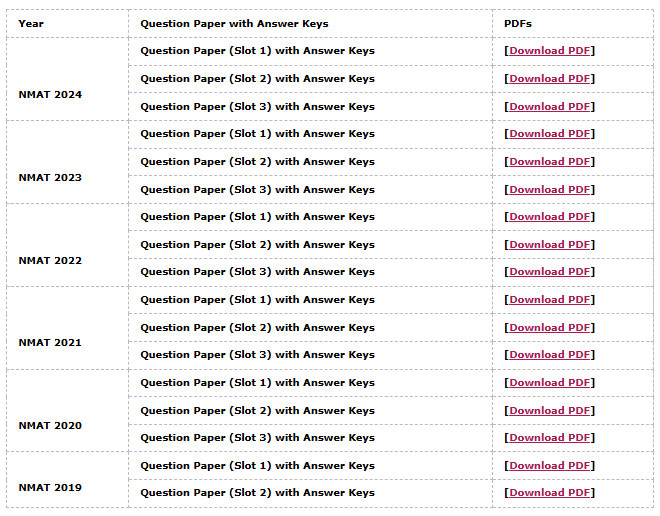
NMAT Previous Year Papers with Solutions (Year-wise PDFs)
Having NMAT previous year papers with solutions is incredibly helpful because they show not just the right answer but also the logic behind it. This is especially useful in NMAT because the exam format is adaptive, and understanding the reasoning makes you improve faster. PDFs allow you to practise offline, analyse calmly, and compare your approach with expert solutions.
Solved NMAT Previous Year Papers? Try a Full-Length Mock Test
Once you complete NMAT previous year papers, the next step is to test your performance in a timed, computer-based mock test. This helps you understand how quickly you can attempt questions while maintaining accuracy.
NMAT mock tests help you:
- Improve sectional speed
- Practice adaptive difficulty levels
- Plan strategy for multiple attempts
Year-Wise Highlights of NMAT PYQs
NMAT 2023
- Moderately difficult
- Logical Reasoning slightly challenging
- Quant was lengthy but solvable
- Great for understanding new trends
NMAT 2022
- Balanced paper
- Language Skills reading-heavy
- Quant included many calculation-based problems
- LR required close attention
- Good for speed-building
NMAT 2021
- High time pressure
- Quant tougher than usual
- LR straightforward
- Ideal for learning time management
NMAT 2020
- One of the easiest years
- Quant patterns very predictable
- Excellent starting point for beginners
These yearly insights help you decide which papers to practise first, depending on your comfort level.
Why Solving NMAT Previous Year Papers Is Essential
1. Understand the Exam Pattern
NMAT’s unique adaptive format and strict timing require a different strategy than CAT or XAT. PYQs reveal:
- Distribution of question types
- Difficulty transitions
- Topic weightage
- Logical reasoning themes
- Language comprehension style
2. Identify Repeated Question Types
Some topics consistently appear:
- Arithmetic
- DI caselets
- Logical patterns
- RC passages on business/social themes
- Grammar corrections
- Series & analogies
Knowing these helps you prioritise your study plan.
3. Build Timing Efficiency
NMAT gives approximately:
- 28 questions in 28 minutes (Language Skills)
- 52 questions in 60 minutes (Quant)
- 40 questions in 38 minutes (LR)
PYQs train you to maintain rhythm and avoid time traps.
4. Improve Accuracy Without Negative Marking Pressure
Since NMAT has no negative marking, PYQs teach you when:
- To take calculated guesses
- To skip fast and come back
- To maximize attempts without losing accuracy
5. Boost Confidence and Reduce Exam Anxiety
Once you’ve solved 5–6 PYQs, the real NMAT feels far less intimidating.
NMAT Exam Pattern 2026 – Updated Format
Understanding the pattern before solving PYQs is crucial.
Total Questions: 108
Sections:
- Language Skills – 36 questions
- Logical Reasoning – 36 questions
- Quantitative Skills – 36 questions
Marking Scheme:
- +1 for every correct answer
- No negative marking
Sectional Timing (Strict):
You cannot return to a section once it ends.
This makes section-wise strategy extremely important.
Adaptive Nature:
Performance on early questions affects later ones.
Thus:
- Accuracy early on is vital
- Guessing too early may reduce your question difficulty level
NMAT Syllabus 2026 – Section-Wise Breakdown
1. Language Skills
PYQs show frequent question types such as:
- Reading Comprehension
- Cloze tests
- Para jumbles
- Analogy-based vocabulary
- Grammar corrections
- Synonyms/antonyms
RC passages are shorter but require fast reading.
2. Quantitative Skills
Common recurring themes:
- Arithmetic (ratios, percentages, averages)
- Algebra
- Number systems
- Mensuration
- Data Interpretation (tables, charts, caselets)
- Simple equations
- Probability & permutations (occasionally)
Most quant questions are straightforward but slightly calculation-heavy.
3. Logical Reasoning
PYQs consistently include:
- Arrangements
- Direction sense
- Coding–decoding
- Series
- Strengthen/weaken questions
- Assumption/inference-based reasoning
- Decision-making puzzles
NMAT LR blends verbal and non-verbal reasoning.
How to Use NMAT Previous Year Papers Effectively
1. Start by Attempting One Untimed Paper
This introduces you to:
- Style
- Structure
- Difficulty
- Question flow
2. Then Attempt Timed PYQs Under Real Conditions
Follow official sectional timings.
Do not pause or switch sections — simulate the actual exam.
3. Perform Deep Error Analysis
Look for:
- Questions you solved incorrectly
- Questions where your logic was flawed
- Questions that consumed too much time
- Recurring mistake patterns
4. Build a Section-Wise Strategy Based on PYQs
For example:
- Start Language Skills with vocabulary and grammar
- Attempt easy LR series before complex puzzles
- Solve arithmetic-based quant before DI sets
5. Maintain an NMAT Error Journal
Track:
- Weak topics
- Repeated errors
- Timing problems
- Difficult question types
Review this weekly.
6. Combine PYQs With Mocks
A strong weekly plan could be:
- Weekdays: Topic-wise drills
- Weekends: Full-length NMAT mock or PYQ
- Post-test: 1–2 hours of detailed analysis
NMAT PYQ Difficulty Level Analysis (Year-wise Trends)
1. Quantitative Skills
Quant difficulty has remained mostly moderate.
Trends show:
- DI caselets getting more frequent
- Calculation-heavy arithmetic topics
- Limited high-level algebra or geometry
2. Logical Reasoning
Sometimes lengthy but predictable.
PYQs reveal:
- Pattern-based series
- Familiar puzzle structures
- Many verbal reasoning questions
3. Language Skills
Difficulty varies by year.
Sometimes RC becomes denser, sometimes grammar dominates.
Overall Difficulty Trend: Moderate
NMAT aims for balance.
It is not as difficult as CAT, but the adaptive nature demands accuracy and speed.
Expected NMAT Cutoff Trends
Cutoffs differ based on difficulty, but past trends offer realistic guidance:
NMIMS Mumbai
- Cutoff: 235–250+
Other NMIMS Campuses
- Cutoff: 200–215
Other B-Schools (General Range)
- Many institutes accept 180–200+
What PYQs Teach About Cutoffs:
- Small score differences drastically change percentiles
- High accuracy early in sections increases your adaptive score
- Overattempting without accuracy reduces the quality of questions shown later
Additional NMAT Preparation Tips Based on PYQs
1. Practice Speed + Accuracy Together
Because of adaptive scoring, accuracy matters more than quantity.
2. Read Daily to Improve RC
NMAT RCs are short but inference-heavy.
3. Strengthen Arithmetic
PYQs show arithmetic dominates quant.
4. Work on Puzzle Selection
Not all LR puzzles are worth solving — learn to skip time-consuming ones.
5. Use On-Screen Calculator Strategically
Use it for verification, not for every calculation.
6. Give Multiple Attempts (If Possible)
Many students improve significantly on the second attempt because they:
- Understand timing better
- Are familiar with the interface
- Perform more confidently
Why ITM Is a Top Choice After NMAT
1. Strong Industry Academic Curriculum
ITM Business School focuses on:
- Case-based teaching
- Practical projects
- Industry immersion
2. Multiple Specializations
Including:
- Marketing
- Finance
- HR
- Business Analytics
- Operations
- FinTech
- Retail Management
3. Admissions Through NMAT Scores
ITM accepts:
- NMAT
- CAT
- XAT
- GMAT
- CMAT
- ATMA
Selection includes:
- Entrance score
- Academic background
- Micro-presentation
- Personal interview
4. Robust Placements
Recruiters include:
- BFSI
- Consulting
- IT
- Retail
- FMCG
- Analytics
Students secure competitive packages and growth roles.
5. Strong ROI
ITM combines:
- Quality learning
- Industry exposure
- Career support
- Moderate fees
Making it a preferred choice for NMAT test-takers.
Conclusion
NMAT Previous Year Papers act as a roadmap for smart preparation. Even though NMAT doesn’t release official question papers, memory-based PYQs and practice sets provide:
- Clear understanding of difficulty
- Detailed insight into question patterns
- Realistic timing practice
- Strong foundation for adaptive test strategy
With consistent practice, error analysis, and the right mix of PYQs + mocks, you can significantly improve your NMAT score.
NMAT 2026 is absolutely achievable if you prepare strategically — not randomly.
FAQs on NMAT Previous Year Papers
Where can I download NMAT PYQs?
On reliable MBA preparation websites and coaching platforms.
Are NMAT PYQs accurate?
They are memory-based, but highly useful for pattern recognition.
How many PYQs should I solve?
At least 5–7 full papers + sectional practice.
Do NMAT questions repeat?
Not exactly, but formats and concepts are similar across years.
Is NMAT tougher than CMAT?
NMAT is more speed-based and adaptive; CMAT is more concept-based.
Can I prepare without coaching?
Yes. PYQs + mocks + structured planning work extremely well.
Does ITM accept NMAT scores?
Yes, ITM considers NMAT scores for PGDM admissions.