SNAP Previous Year Papers: Smart Practice Guide + Mock Test for 2026 Aspirants

Introduction to SNAP Previous Year Papers
SNAP (Symbiosis National Aptitude Test) is a short, intense, high-speed exam. With just 60 questions in 60 minutes, it demands quick thinking, smart skipping, and precision.
SNAP Previous Year Papers help aspirants understand:
- How speed influences accuracy
- What types of questions repeat
- How to optimise attempts
- How to reduce silly mistakes
- What difficulty level to expect across sections
Students often treat these papers like mini-mocks, using them to train their reflexes and build familiarity. For many aspirants, solving past SNAP papers marks the transition from “studying concepts” to “applying concepts under pressure.”
Memory-based papers also play a useful role. Even though SNAP does not officially release question papers, memory-based reconstructions help recreate realistic practice sets for candidates who want to simulate the exam.
Free SNAP Previous Year Papers (Solved PDFs)
Get all papers + solutions in one place
Practice SNAP 2026 with a Free Mock Test
Solving SNAP previous year question papers helps you understand the type of questions asked in the exam. However, mock tests help you experience the real SNAP exam environment, where speed and accuracy matter the most.
Our SNAP mock test is designed as per the latest exam pattern and covers all three sections:
- General English
- Analytical & Logical Reasoning
- Quantitative, Data Interpretation & Data Sufficiency
This mock test helps you evaluate your preparation level before the actual SNAP 2026 exam.
What Are SNAP Previous Year Papers?
Because SNAP does not publish its papers officially, PYQs usually refer to:
- Memory-based question papers
- Reconstructed papers from coaching institutes
- Section-wise PDFs prepared from past SNAP trends
- Mock tests designed using real SNAP difficulty
These papers mimic the actual structure and provide:
- Realistic framing
- Time-sensitive question distribution
- Sectional balance between English, Reasoning, and Quant
Many students use them to benchmark their performance and track their preparation month-by-month.
SNAP Previous Year Papers with Solutions (PDF Download – Year wise)
Most aspirants prefer SNAP Previous Year Papers PDFs because they’re easy to download, store, print, and attempt multiple times. When these PDFs come with solutions, you not only see the right answer but also understand the approach, which is crucial in a speed exam like SNAP.
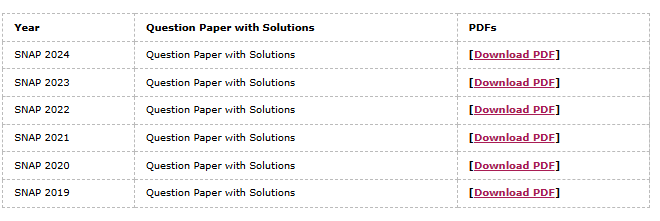
A typical year-wise view looks like this:
Year | Why this paper is useful |
SNAP 2024 Paper PDF | Reflects the most recent pattern, difficulty mix, and section balance. Great for benchmarking your current preparation level. |
SNAP 2023 Paper PDF | Known for moderate quant, scoring English, and a reasoning section that rewarded quick pattern recognition. Useful to test your speed. |
SNAP 2022 Paper PDF | Featured a mix of straightforward and slightly tricky questions. Ideal to build confidence for students starting PYQ practice. |
SNAP 2021 & older | Help you see how SNAP has remained speed-oriented over time, with minor tweaks in weightage and question style. Good for extra practice. |
Use these PDFs like mini-mocks: set a timer, attempt seriously, then review each solution to refine your strategy.
Solved SNAP Previous Year Papers? Try a Full-Length Mock Test
Once you complete SNAP previous year papers, the next step is to check how well you perform under real exam conditions. A timed mock test helps you practice question selection, manage time efficiently and avoid common mistakes.
Taking mock tests regularly will help you:
- Improve speed across all sections
- Reduce negative marking
- Identify weak areas early
SNAP Exam Pattern & Marking Scheme: Quick Overview
Understanding the test pattern is essential before diving into PYQs. SNAP is designed to be a rapid-fire exam where even a single minute wasted can cost several marks.
SNAP Format (Typical Structure):
- Total Questions: 60
- Total Time: 60 minutes
- Marking Scheme: +1 for correct answer, –0.25 for incorrect
- Sections:
- General English
- Analytical & Logical Reasoning
- Quantitative, DI & Data Sufficiency
Two things define SNAP:
- Speed > Depth
- Smart selection of questions
Students who practise PYQs quickly learn to identify:
- High-scoring opportunities
- Time-consuming traps
- Patterns in question difficulty
This is key to scoring 97–99 percentile.
Section-wise Analysis Based on Previous Papers
1. General English
SNAP’s English section is compact but scoring. Based on previous papers, it usually includes:
- Vocabulary questions (synonyms, antonyms)
- Grammar-based corrections
- Fill-in-the-blanks
- Idioms and usage
- Short reading comprehension passages
Unlike CAT, SNAP RCs are short and manageable. Students with a habit of reading or practising vocab daily often find this section easy to moderate.
2. Analytical & Logical Reasoning
This is SNAP’s most important section, historically carrying the highest weight in determining percentiles. PYQs typically show:
- Series & sequences
- Coding–decoding
- Blood relations
- Puzzles
- Critical reasoning
- Odd-one-out patterns
- Venn diagrams
- Analogies
Reasoning forms the backbone of the exam. With enough PYQ practice, question patterns become much more predictable and easier to solve quickly.
3. Quantitative Aptitude, DI & Data Sufficiency
SNAP quant is moderately easy but extremely time-sensitive. PYQs reveal common topics like:
- Percentages
- Ratios
- Averages
- Profit & loss
- Time–speed–distance
- Simple algebra
- Mensuration basics
- Table/chart-based DI
SNAP does not focus on very advanced maths. Instead, it demands speed with accuracy. A strong foundation in arithmetic gives you a massive advantage.
Difficulty Level Trend Analysis (Year-wise)
After analysing PYQs, one trend stands out clearly:
SNAP is not difficult — SNAP is fast.
Most questions fall in the easy-to-moderate range, but the pressure of 60 minutes for 60 questions turns everything into a speed game.
Key observations from previous papers:
- Quant difficulty has reduced slightly over the years, focusing more on arithmetic.
- Reasoning remains the highest-scoring section, especially for those who practise aggressively.
- English difficulty is stable, but vocabulary is tested frequently.
- Option traps exist — many students lose marks due to rushing.
SNAP rewards those who can balance speed + accuracy + selective attempt strategy.
Benefits of Solving SNAP Previous Year Papers
1. Realistic Timing Practice
SNAP’s biggest hurdle is its one-minute-per-question format. PYQs train your mind to think fast and avoid overanalysis.
2. Understanding Question Patterns
Common question types reappear every year, especially in:
- Reasoning
- Arithmetic
- Vocabulary
Once you know what to expect, your accuracy naturally improves.
3. Improving Decision-Making
SNAP punishes overthinking. PYQs help you learn:
- When to skip
- When to attempt
- When to guess safely
This directly boosts percentile performance.
4. Increasing Confidence
After you have solved 5–6 PYQs, SNAP no longer feels unpredictable.
This psychological edge matters immensely during the real exam.
How to Use SNAP Previous Papers for Effective Preparation
1. Start With 1–2 Untimed Papers
Understand your natural solving speed and comfort level.
2. Move to Full-Length Timed Attempts
Set a timer for 60 minutes — NO pausing, NO breaks.
Simulate exam conditions.
3. Analyse Every Attempt Thoroughly
Check:
- Time taken on each section
- Where accuracy dipped
- Which questions you solved too slowly
- Which ones were easy but skipped
Analysis > solving more papers.
4. Build a Smart Skip Strategy
SNAP experts often say:
“Your percentile is decided by what you don’t attempt.”
Avoid:
- Long puzzles
- Lengthy DI sets
- Heavy algebra questions
PYQs teach you to recognise time-consuming items instantly.
5. Combine PYQs with Mocks
A balanced weekly strategy:
- Weekdays: small drills + concept revision
- Weekends: 1 PYQ or 1 full-length mock
- After each test: detailed analysis
6. Track Errors in a Logbook
Maintain a simple log for:
- Wrong answers
- Question types you repeatedly struggle with
- Time-killers
- Vocabulary mistakes
Review this log every week.
SNAP Cutoff Trends Over the Years
Previous SNAP papers give a good estimate of expected cutoffs.
Top Institutes like:
- SIBM Pune
- SCMHRD Pune
Usually demand high percentiles (96–99+) due to competition and brand value.
Other SIU Colleges
Such as SIIB, SICSR, SIMS, SIOM, and others, have lower cutoffs in the 80–90 range depending on the program.
Why PYQs Matter for Cutoffs
SNAP cutoffs move sharply because:
- The test is short
- A few marks can change percentile drastically
- Accuracy matters much more than attempting too many questions
Solving PYQs helps you aim for realistic target scores.
SNAP Preparation Tips Based on PYQ Analysis
1. Prioritise Reasoning First
The fastest scoring section with the highest impact on cutoffs.
2. Become an Arithmetic Expert
Arithmetic dominates SNAP quant. Master it early.
3. Do Daily 30-Minute Speed Drills
Short, intense drills improve stamina and focus.
4. Keep Vocabulary Active
Even 1000 high-frequency words can boost English performance.
5. Learn to Detect “Trap” Options
PYQs reveal common distractor patterns.
6. Never Spend More Than 90 Seconds on Any Question
If it’s taking too long → skip.
Why Choose ITM for MBA After SNAP?
1. Industry-Focused Curriculum
ITM Business School blends:
- Case-based learning
- Live projects
- Internships
- Corporate mentoring
This makes their programs practical and career-oriented.
2. Flexible Admission Criteria
ITM accepts:
- SNAP
- CAT
- CMAT
- XAT
- GMAT
- ATMA
Candidates go through:
- Interviews
- Micro-presentations
- Profile evaluations
3. Strong Placement Records
Recruiters from:
- BFSI
- Consulting
- IT
- Retail
- Analytics
- FMCG
Students receive roles in sales, marketing, finance, HR, operations, and analytics.
4. Balanced ROI
ITM is known for its:
- Reasonable fees
- Good exposure
- Diverse opportunities
- Consistent placements
It appeals to aspirants who want practical learning beyond brand-chasing.
Conclusion
SNAP Previous Year Papers act like a shortcut to understanding how the exam truly works. They reveal the real pattern, difficulty level, and speed required to perform well.
If you combine PYQs with smart practice, focused revision, and regular mocks, SNAP becomes much more predictable and less intimidating.
Treat each paper as a learning tool, not a marks sheet. With consistent effort and honest analysis, you can turn SNAP 2026 into a genuine opportunity for your MBA journey.
FAQs on SNAP Previous Year Papers
Where can I get SNAP previous year papers?
You’ll find them on exam prep sites, coaching platforms, and memory-based student discussions.
Are SNAP previous papers available with solutions?
Yes, many coaching institutes and blogs provide answer keys and detailed explanations.
Do questions repeat from SNAP previous papers?
Exact questions rarely repeat, but formats, concepts, and difficulty styles often do.
How many SNAP PYQs should I solve?
Aim for at least 5–7 full papers, plus sectional practice from older sets.
Are SNAP papers easier than CAT?
Generally yes, but SNAP is faster and demands sharper time management.
When should I start solving previous papers?
Ideally after basic concepts are covered, around 2–3 months before the exam.
Can SNAP PYQs replace mock tests?
No, use both. PYQs show reality; mocks test adaptability.